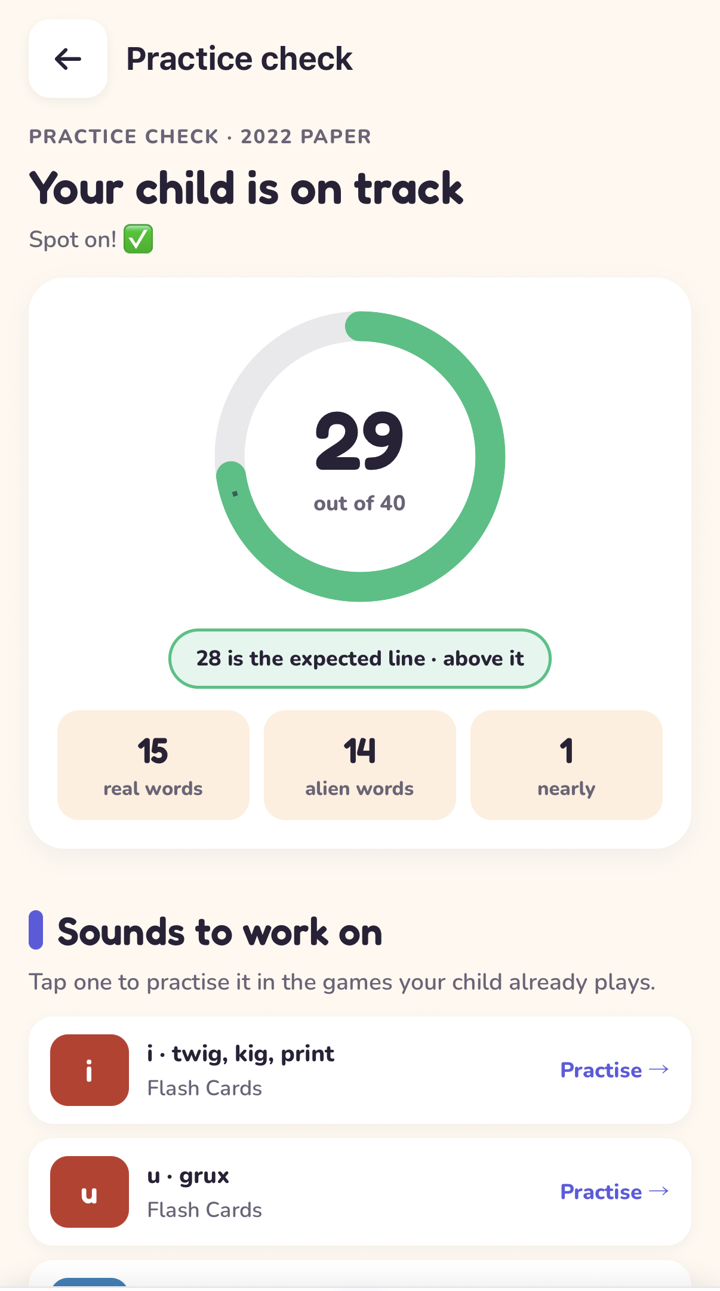
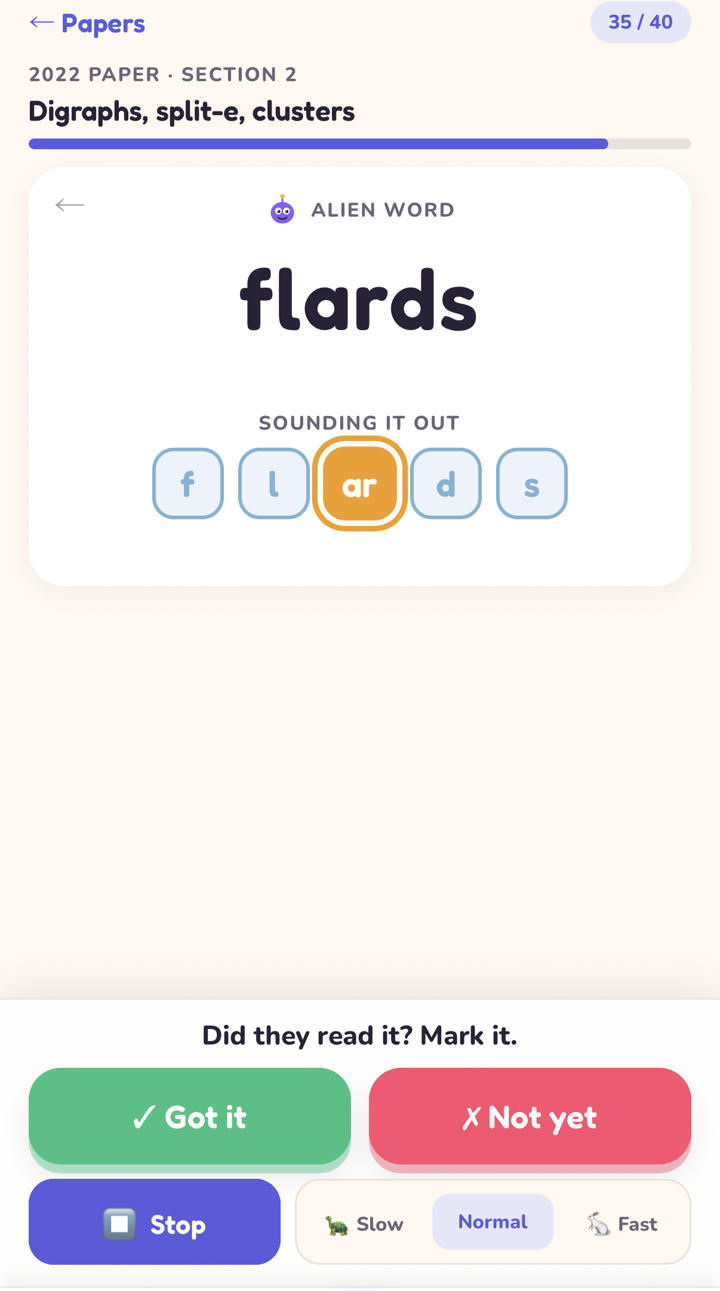
Vap. Shup. Dreem. Blorst. Alien words are made-up words that follow the normal rules of English spelling but don't mean anything. In the phonics screening check each one has a little alien drawing next to it, so children know not to look for a meaning. Twenty of the forty words in the check are alien words.
Why they exist
The check is meant to test one thing: can a child decode, that is, turn letters into sounds and blend them into a word? Real words can't test that cleanly, because a child might just recognise them. Most six-year-olds can read ship on sight. But none of them has seen shup before. The only way to read it is to know that sh says /sh/, then blend /sh/ /u/ /p/. So alien words are the purest test of phonics there is, and that's exactly why they're there.
Why confident readers get them wrong
Here's the trap. A child who reads a lot has a big bank of words in their head, and their brain is constantly pattern-matching. Shown shup, that brain says "that's nearly ship" and out comes ship. Marked wrong. Shown vap, it says "that's van". Wrong again. Strong readers can lose four or five marks this way, purely from over-correcting.
The fix is not more reading. It's practising the specific skill of reading exactly what's on the page, even when it's nonsense. That's a habit, and it takes a couple of weeks of light practice to build.
What alien words look like in the check
They're built from the same phonics patterns as the real words, in the same order of difficulty:
- Simple three sounds: vap vap, lut, mip
- With a digraph: shup shup, chock, thend
- With a vowel digraph or trigraph: dreem dreem, bloit, quigh
- Split digraph: pome, frute, bline
- Adjacent consonants: blorst, strimp, flend
Notice that they're always pronounceable. There's never a trick, just the ordinary sounds of English in an unfamiliar order.
How to practise at home
- Make it a game, not a test. "Alien names!" works. Each word is the name of an alien; your child has to read the name to say hello.
- The rule is "read what's there". If they say a real word instead, don't say "wrong". Say "close, but look again, what's this sound?" and point to the phonogram they changed.
- Sound it out visibly. Cover all but the first phonogram, reveal one at a time, then blend. This stops the brain from jumping to the nearest real word.
- Five or six a day is plenty. Alien words are effortful. A short burst beats a long slog.
- Mix them with real words. That's how the check does it, and it stops your child switching into "nonsense mode" and reading the real ones as alien.
Alien words beyond the check
They're not just a test trick. Every long, unfamiliar word your child meets in a chapter book in a few years (photosynthesis, Mesopotamia) is an alien word the first time. A child who can calmly sound out blorst at six is a child who won't skip the hard words at nine.
Questions parents ask
Are alien words the same as nonsense words or pseudo-words?
Yes. "Pseudo-words" is the official term in the check, "nonsense words" is what US screeners like DIBELS call them, and "alien words" is what schools and children call them because of the alien pictures.
How many alien words are in the phonics screening check?
Twenty of the forty words. They're mixed in with the real words in sections of four, so children don't get a run of alien words in a row.
My child reads well but gets the alien words wrong. Why?
Because a strong reader's brain autocorrects the nonsense word into the nearest real one. It's very common and very fixable with a couple of weeks of light practice at reading exactly what's written.
Should I worry if my child finds them hard?
Not at all. Alien words are effortful by design. The point is to find out which sounds still need work, and then work on those. If a specific pattern keeps tripping them (say igh or ure), that's your practice list.