What is a phonogram?
A phonogram is a letter, or a small group of letters, that stands for one sound in a word, like igh in night. About 70 phonograms cover almost all of English, so a child who knows them can sound out and spell far more words than they could ever memorise one at a time.
Some phonograms are a single letter: mta. Others are a team of two, three or four letters working together: sheeigheigh. Each team makes one sound, so your child reads it as one chunk.
Phonogram Fun teaches the 70 phonograms used in the Spalding method (Phonogram Fun is independent and not affiliated with Spalding Education International).
Phonogram vs phoneme vs grapheme vs digraph
| Term | What it means | Example |
|---|---|---|
| Phoneme | A single sound in spoken language. You hear it; you can't see it. | the /ī/ sound in night |
| Grapheme | The letter or letters that write a sound down in a particular word. | igh in night, y in my |
| Phonogram | A written unit taught as a fixed card, with all of its sounds learned together. | igh (one sound), ea (three) |
| Digraph | Two letters that make one sound. Three letters is a trigraph. | sh, ee, ck; igh is a trigraph |
The practical difference: a phonogram is learned with all its sounds at once, so when your child meets ea they already know what to try. For trigraphs, split digraphs, blends and the rest, see Digraph vs phonogram vs phoneme vs grapheme.
Why 70?
English has 26 letters but around 44 sounds, depending on your accent. So English uses letter teams. Take the 26 single letters (q always travels with u, so it's learned as qu), add the 44 common letter teams, and you land on 70 phonograms.
Many phonograms also make more than one sound:
- ea makes three: /ē/ in eat, /ĕ/ in head, /ā/ in break.
- ch makes three: /ch/ in much, /k/ in school, /sh/ in chef.
- ough makes six: though, through, rough, cough, thought and drought. More in The ough words, explained.
Children learn the sounds in a fixed order, most common first, so they have a plan: try the first sound, and if that isn't a real word, try the next.
How to sound out a word with phonograms
Take sight: sight
- Find the letter teams first. In sight, the team is igh.
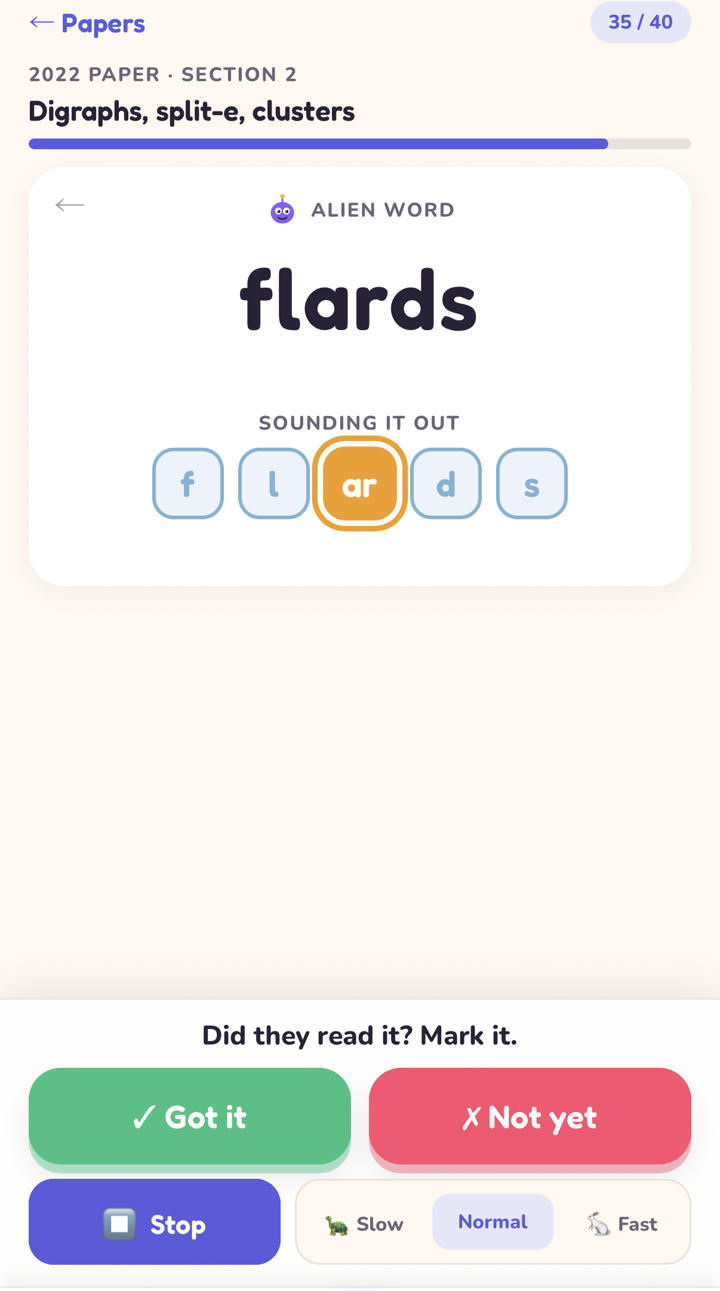
- Split the word into phonograms. s + igh + t: five letters, three sounds.
- Say each sound, then push them together. /s/ /ī/ /t/, sight.
The same igh is in night (n + igh + t) and in sigh, the example word on the chart. Try each: it's each Use the first sound of each team, /ē/ and /ch/, and you've read it. Type any word into the word analyser on our home page and watch it split into phonogram tiles.
How phonograms help with spelling
Spelling is reading in reverse. When your child has to spell night for Friday's test, they don't need to remember n-i-g-h-t as five arbitrary letters. They need to hear three sounds and choose the right phonogram for the middle one. That's a much smaller job.
Phonograms also shrink the pile of "tricky words". Said and because are usually taught as words to memorise whole. Through phonograms, most of each word is ordinary: in said, the s and d behave normally and only the middle is odd; in because, the b, c and au are doing everyday jobs and s is making /z/, one of its two normal sounds. Some words still need learning by heart, but fewer than children think.
Phonograms at each age
- At 2 and 3: ears only: rhymes and listening games, no letters.
- At 4: single-letter phonograms, said as pure sounds (/m/, not "muh").
- At 5: blending, and the first letter teams such as sh, ch, th and ee.
- At 6: phonograms with several sounds (ea, ow, ou) and the Year 1 phonics check.
- At 7: rarer teams like ti, ci, dge and eigh, and the spelling rules.
Questions parents ask
Is a phonogram the same as a sound?
Not quite. A sound (phoneme) is what you hear; a phonogram is what you see written. igh is one phonogram that writes one sound, /ī/. Some phonograms can write several sounds: ea says /ē/ in eat, /ĕ/ in head and /ā/ in break.
How many phonograms are there?
The usual teaching set is 70: the 26 single-letter phonograms of the alphabet (q is always written qu) plus 44 letter teams such as sh, ee, igh and eigh. Together they spell the vast majority of English words.
What order should my child learn phonograms in?
Single letters first, each with all of its sounds, then the common letter teams (sh, ee, th, ow, ou, oo, ch, ar), then the rarer ones like eigh, ti and ci. Our chart lists them in that order.
Do phonograms help with the Year 1 phonics check?
Yes. Most of the check is about spotting letter teams and blending them, including in made-up alien words. A child who reads ar, igh or ow as one chunk, rather than letter by letter, has a much easier time.