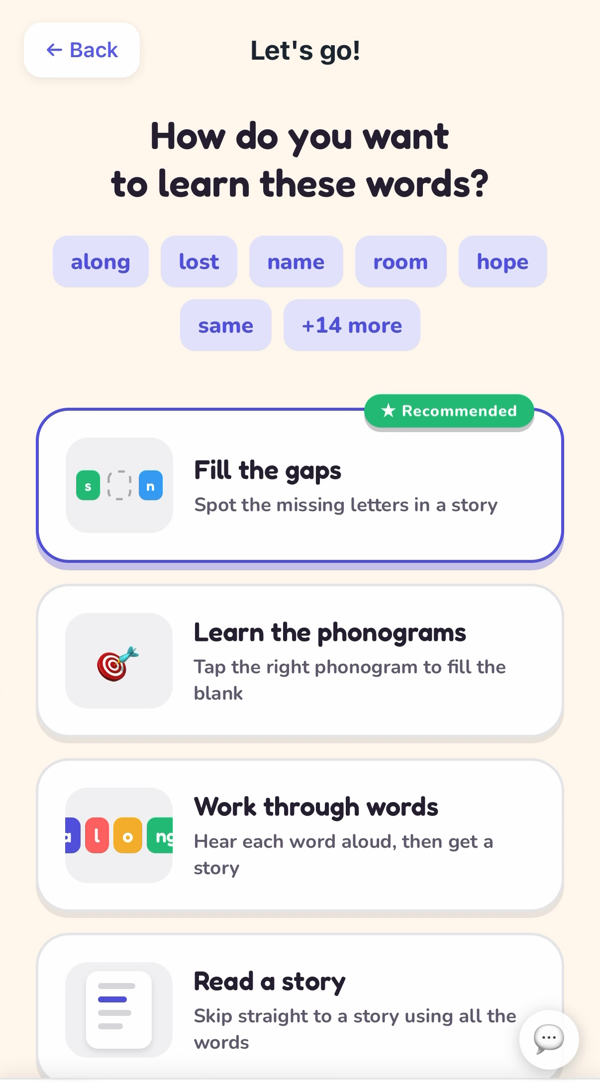
In the first year of school, most of what Australian children read and write comes from a small pool of short, common words: at, in, can, big, the, this, see, day. Schools often call them sight words or high-frequency words. The lists below are the 100 Kindy words built into Phonogram Fun, ten a week for ten weeks, grouped by sound so each week builds on the last.
Use them as they are, print them for the fridge, or keep them for the weeks when nothing comes home. If your school sends its own list, use that one: you can photograph it into Phonogram Fun and the words turn into sound-it-out practice. The short routine further down works with any list.
What is Prep called in each state?
The first year of school goes by a different name depending on where you live, which makes searching for "Prep sight words" or "Kindy sight words" confusing. It's the same year everywhere: the full-time year before Year 1, usually the year a child turns five or six.
| Where | First year of school | Watch out for |
|---|---|---|
| NSW, ACT | Kindergarten (Kindy) | This is the first year of school proper. |
| Queensland | Prep | "Kindy" here means the year before Prep. |
| Victoria | Prep (Foundation) | "Kinder" means the year or two before Prep. |
| Tasmania | Prep | Kindergarten is the year before Prep. |
| Western Australia | Pre-primary | Kindergarten is the year before Pre-primary. |
| South Australia | Reception | |
| Northern Territory | Transition | |
| Australian Curriculum | Foundation | The national name, so "Foundation sight words" means the same year. |
So a "Kindy" list from a Sydney school and a "Prep" list from a Brisbane or Melbourne school are for the same age group. The app labels this year K.
The Prep and Kindy list, week by week
The coloured tiles on each card are that week's focus sounds. All ten weeks print on one A4 page.
Week 1 · Simple Short Vowels
aiou- at
- it
- in
- on
- up
- me
- no
- am
- an
- if
Week 2 · CVC Words — A
a- bat
- cat
- hat
- mat
- sat
- fat
- rat
- van
- man
- can
Week 3 · CVC Words — I
i- big
- dig
- fig
- pig
- wig
- hit
- sit
- bit
- fit
- kit
Week 4 · CVC Words — O
o- hot
- pot
- dot
- got
- lot
- not
- rot
- top
- mop
- cop
Week 5 · CVC Words — U
u- bud
- bug
- dug
- fun
- gun
- run
- sun
- tub
- rub
- hub
Week 6 · SH words
sh- ship
- shop
- shed
- fish
- wish
- dish
- bash
- cash
- gash
- lash
Week 7 · TH words
th- the
- this
- that
- then
- them
- with
- bath
- math
- cloth
- moth
Week 8 · CH words
chea- chin
- chip
- chop
- rich
- much
- such
- each
- peach
- teach
- beach
Week 9 · EE words
ee- see
- bee
- fee
- tree
- free
- three
- keep
- deep
- sleep
- sheep
Week 10 · AY and AI words
ayai- day
- say
- way
- pay
- play
- stay
- rain
- main
- pain
- train
Prep and Kindy sight words, weeks 1 to 10 · free to print from phonogramfun.com/learn
Sight words or sound-it-out words?
"Sight word" gets used two ways. Some teachers mean any very common word a child should read instantly; others mean a word that can't be sounded out and has to be memorised. The first meaning is useful. The second covers far fewer words than most parents expect.
Almost every word on these lists can be sounded out with the first sound of each phonogram: can is can and ship is ship. Even me and no are regular once your child knows that e and o can say their names. A child who reads this by sound three times usually reads it by sight on the fourth. That's how words become sight words: by being decoded often, not by being drilled as shapes.
The handful of genuinely odd everyday words, like said, was and you, are covered in Common exception words, grouped by the one part of each word that breaks the pattern.
What the words have in common
Week 1 is two-letter words: at, it, in, on, up, am, an, if, each a short vowel and one consonant. Me and no end in a vowel that says its name, which is a useful early lesson: a letter can make more than one sound.
Weeks 2 to 5 are three-letter words, one short vowel at a time: a in cat, hat, van, i in big, sit, kit, o in hot, top, mop and u in sun, bug, tub. Teachers call these CVC words: consonant, vowel, consonant. Changing one letter makes a new word (bat, cat, hat, mat), which is the moment many children realise reading is a code they can crack. Week 3's kit uses k rather than c because c before i says /s/, as in city. Week 5's bud, dug and tub are good practice for children who still mix up b and d.
Week 6 brings the first letter team: sh, two letters making one sound. It sits at the start (ship, shop, shed) and at the end (fish, wish, dish, cash). Fish is four letters but three sounds, so children start counting sounds, not letters.
Week 7 is th, which has two sounds: the buzzy one in the, this, that, then, them and the quiet one in bath, moth, cloth. Put a hand on your throat to feel the difference. (The app's list says math; most Australian children will say and write maths.)
Week 8 is ch in chin, chip, chop, rich, much, such, and sneaks in a vowel team: ea saying /ē/ in each, peach, teach, beach.
Week 9 is ee in see, bee, tree, keep, sleep, sheep, with consonant blends where you hear both sounds: tr, fr, sl, and thr in three.
Week 10 is two ways to write /ā/: ay at the end of a word (day, say, play, stay) and ai in the middle (rain, main, train). ai never ends an English word, which is why day isn't spelled "dai". That one rule saves a lot of guessing later.
How to practise Prep sight words at home
Two or three words a night is plenty at this age, and five minutes beats twenty. Keep it spoken and playful; writing comes last.
- Hear it. Say the word and use it in a short sentence: "sun. The sun is hot."
- Say the sounds. Say it slowly, one sound per finger: /s/ /ŭ/ /n/. Pure sounds, so /s/ not "suh". In Phonogram Fun, tapping a word splits it into coloured tiles and plays each sound.
- Build it. Make the word with magnetic letters or letter cards, then swap one letter to make a new word: sun to run to bun.
- Write it. Your child says each sound as they write it, then reads it back. If a letter goes wrong, point to it and ask for the sound, rather than fixing it for them.
- Find it. Spot the word in a picture book or on a sign. Finding a word in real life is the best reward there is at five.
For a fuller routine, including what to do when it goes wrong, see How to practise spelling words without tears.
After Prep: Year 1
In Year 1 the lists get a little longer and add more letter teams, and in Term 3 most states run the Year 1 Phonics Check. The next set of weekly lists is Year 1 spelling words. For what's normal at this age, see Phonics for 5 year olds.
Questions parents ask
What is Prep called in my state?
The first year of school has a different name in each state. It's Kindergarten (Kindy) in NSW and the ACT, Prep in Queensland, Victoria and Tasmania, Pre-primary in WA, Reception in SA and Transition in the NT. The Australian Curriculum calls it Foundation. It's the same year everywhere: the year children turn five or six.
How many sight words should a Prep child know?
There's no national number. Each school chooses its own high-frequency words and works through them across the year at its own pace. What matters more than a count is that your child can sound out short words like cat, ship and see by the end of the year, because that skill keeps working on every new word.
Are these the official Foundation sight words?
No. Australia has no official Prep or Foundation word list. The Australian Curriculum describes the phonics skills children should build, and each school picks its own words. These lists are the 100 Kindy words built into Phonogram Fun, in a typical phonics order: short vowels, then sh, th, ch, ee and ay/ai.
Should my child memorise sight words or sound them out?
Sound them out first. Most words on Prep and Kindy sight word lists, like at, can, big, this and see, are completely regular once your child knows the sounds. Only a handful, like said or was, have an odd part, and even those are mostly regular. Reading them by sound first means they end up known by sight anyway.
When do spelling lists start in Prep or Kindy?
It depends on the school. Some send home a short list during the first year of school, others wait until Year 1. If no list comes home, the ten weeks on this page are a gentle way to practise at home, two or three words a night.