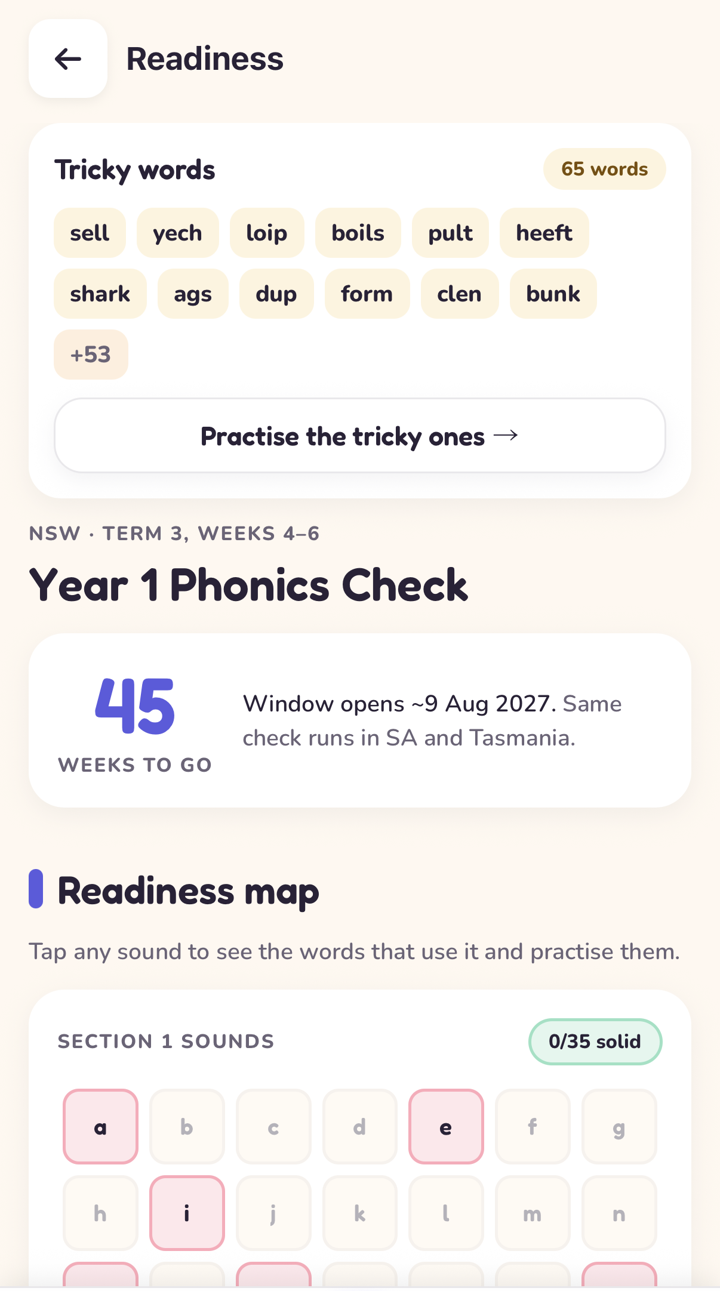
In most Australian schools, Year 1 is when the weekly spelling list arrives in earnest. Most NSW, VIC and QLD schools send home somewhere between 8 and 12 words at the start of the week, usually built around one sound or pattern, with a quick test on Friday, from Term 1 right through to Term 4. The list runs alongside the Year 1 Phonics Check, which most states hold in Term 3: forty words read aloud to the teacher, half of them made up.
Below are 5 weekly Year 1 lists, ten words each, in a typical phonics order. Use them as they are, print them for the fridge, or keep them for the weeks when no list comes home. If your school sends its own list, use that one instead: you can photograph it into Phonogram Fun and the week's words turn into sound-it-out practice. Either way, the ten-minute routine further down works with any list.
The Year 1 list, week by week
The coloured tiles on each card are that week's focus sounds. The whole list prints on one A4 page.
Week 1 · Short Vowels & Consonants
aeiou- at
- it
- in
- on
- up
- me
- do
- an
- no
- am
Week 2 · Short Vowels with H and R
hr- his
- her
- has
- had
- him
- hot
- run
- red
- sat
- set
Week 3 · SH, TH, CH Phonograms
shthch- the
- this
- that
- with
- shop
- ship
- fish
- chin
- chip
- rich
Week 4 · High Frequency Words + AY/EE
ayee- and
- but
- not
- for
- got
- see
- say
- day
- way
- may
Week 5 · CK and NG Blends
ckng- back
- pick
- lock
- duck
- ring
- sing
- long
- hang
- plan
- flat
Year 1 spelling words, weeks 1 to 5 · free to print from phonogramfun.com/learn
What the words have in common
Week 1 starts with the shortest words there are: at, it, in, on, up, an, am. Each is one short vowel and one consonant, so a child can hear both sounds clearly and write them in order. Three words sneak in a vowel that isn't short: me and no end in a vowel that says its name, and do uses o's third sound, /ōō/. That's a useful early lesson: one letter can make more than one sound.
Week 2 adds h and r to build three-letter words: had, him, hot, red, run, sat, set. Two patterns are worth pointing out. In his and has, the s says /z/, its second sound. And her uses er, the first letter team on the list.
Week 3 is built on letter teams: sh, th and ch, two letters making one sound. Ship, fish, chip, rich and with are four letters but three sounds, which is the moment a child learns to count sounds rather than letters. The is here too, because it's the most common word in English.
Week 4 mixes high-frequency words (and, but, not, got, for) with the first vowel teams: ee in see, and ay in say, day, way and may. Ay is a good one to notice: it's how English usually writes /ā/ at the end of a word.
Week 5 puts ck and ng at the end of words (back, pick, lock, duck, ring, sing, long, hang) and brings in the first consonant blends: in plan and flat two consonants sit side by side and you hear both. So the arc across the five weeks is short vowels, then letter teams, then vowel teams, then word endings and blends.
How to practise a Year 1 list in ten minutes
Three or four words a night is plenty. Take them one at a time through these five steps.
- Look, say, sound. Read the word together, then say it sound by sound while pointing at each phonogram: ship is /sh/ /ĭ/ /p/, three sounds from four letters. In Phonogram Fun, tapping a word splits it into coloured phonogram tiles and plays each sound.
- Cover, write, check. Cover the word, have your child say the sounds as they write it, then uncover it and check together, one phonogram at a time. Word Climb in the app does the same job as a game: one letter disappears, then two, then the whole word.
- A dictation sentence. Say a short sentence with the word in it and have them write the whole thing: The cat sat on the mat. Sentences catch the words children can spell in a list but not yet in their own writing.
- Mixed revision. Slip in two or three words from earlier weeks. Spelling sticks when old words keep coming back, not when each list is learned on Thursday and forgotten by Monday.
- Celebrate. Stop while it's still going well. Name one specific thing they did (“you remembered the ck in duck”) rather than a general “good job”, and tick off the day.
The longer version, with what to do when a word goes wrong and how to spread a list across the week, is in How to practise spelling words without tears.
Prep, Kindy and Year 2
Spelling lists don't start or stop in Year 1. The first year of school goes by different names around Australia: Kindergarten (Kindy) in NSW and the ACT, Prep in Victoria, Queensland and Tasmania, Reception in South Australia and Pre-primary in WA. For that year Phonogram Fun has 10 weekly lists, 100 words in all, moving from short-vowel words like at and big to sh, th, ch, ee and ay/ai. Year 2 has another 10 lists (100 words) working through oa, igh, kn, wr, ph, ir, er, ur, aw, and oi/oy. There are 6 lists for Year 3 and a challenge list each for Years 4, 5 and 6.
Both are on their own pages, free to print: Prep and Kindy sight words and Year 2 spelling words.
Year 2 is also when the trickier everyday words pile up: common exception words like could, people and because. For what children are learning at each age:
- Phonics for 5 year olds: Prep or Kindy, blending and the first letter teams.
- Phonics for 6 year olds: Year 1, alternative spellings and the phonics check.
- Phonics for 7 year olds: Year 2, suffix rules and the words that break the rules.
Questions parents ask
How many spelling words a week in Year 1?
Most Australian Year 1 classes send home somewhere between 8 and 12 words a week, usually grouped around one sound or pattern, with a quick test at the end of the week. The lists on this page have 10 words each. If your child's list is longer, split it across the week rather than doing every word every night.
Are these the official Australian Curriculum spelling words?
No. There is no single official Year 1 spelling list in Australia. The Australian Curriculum sets out the phonics and spelling skills children should build, and each school, often each teacher, chooses the words. These lists are a typical phonics-ordered progression: short vowels first, then sh, th and ch, then the first vowel teams, then ck, ng and consonant blends.
What if my school's list is different?
Use your school's list: it's the one your child will be tested on. The ten-minute routine on this page works with any list, and you can photograph your school's list into Phonogram Fun so the week's words become sound-it-out practice and games. Keep these lists for extra practice or for weeks when no list comes home.
When is the Year 1 phonics check?
In Term 3 of Year 1 in most states. Six states (SA, NSW, Tasmania, Queensland, Victoria, and WA public schools) now run it, and in the ACT and NT it's up to the school. Children read 40 words aloud to their teacher, half of them made-up alien words. It takes 5 to 10 minutes and there's no writing.